
Principle of automotive air conditioning blower
Abstract: The automotive air conditioning system is a device that cools, heats, ventilates, and purifies the air inside the vehicle cabin. It provides a comfortable riding environment for passengers, reduces driver fatigue, and enhances driving safety. The air conditioning unit has become one of the indicators to measure whether an automobile is fully functional. The automotive air conditioning system consists of a compressor, an air conditioning blower, a condenser, a receiver-drier, an expansion valve, an evaporator, and a blower. This article mainly introduces the principle of the automotive air conditioning blower.
Keywords: Blower, Control Principle. With global warming and increasing demands for a comfortable driving environment, more and more cars are equipped with air conditioning systems. According to statistics, 78% of cars sold in the US and Canadian markets in 2000 were already equipped with air conditioning, and now, conservatively speaking, at least 90% or more are. In addition to providing a comfortable driving environment, readers who are car users should understand the principles behind automotive air conditioning, so that they can more effectively and quickly address unexpected situations.
1. Operating Principle of Automotive Refrigeration System
Operating Principle of Automotive Air Conditioning Refrigeration System
1. Operating Principle of Automotive Air Conditioning Refrigeration System
The cycle of the automotive air conditioning refrigeration system consists of four processes: compression, heat release, throttling, and heat absorption.
(1) Compression process: The compressor sucks in the low-temperature and low-pressure refrigerant gas at the outlet of the evaporator, compresses it into a high-temperature and high-pressure gas, and then sends it to the condenser. The main function of this process is to compress and increase pressure, making the gas easier to liquefy. During the compression process, the state of the refrigerant does not change, but the temperature and pressure continuously increase, forming an overheated gas.
(2) Heat release process: The high-temperature and high-pressure superheated refrigerant gas enters the condenser (radiator) to exchange heat with the atmosphere. Due to the decrease in pressure and temperature, the refrigerant gas condenses into a liquid and releases a large amount of heat. This process serves to remove heat and condense. The characteristic of the condensation process is that the state of the refrigerant changes, that is, it gradually transitions from a gaseous state to a liquid state under constant pressure and temperature. The condensed refrigerant liquid is high-pressure and high-temperature liquid. The refrigerant liquid is subcooled, and the greater the degree of subcooling, the greater its ability to absorb heat during evaporation, and the better the cooling effect, that is, the corresponding increase in cooling capacity.
(3) Throttling process: High-pressure and high-temperature refrigerant liquid is throttled and depressurized by an expansion valve, and discharged from the expansion device in a mist form (fine droplets). The purpose of this process is to cool and depressurize the refrigerant, rapidly transforming it from a high-temperature and high-pressure liquid into a low-temperature and low-pressure liquid, which facilitates heat absorption, controls the cooling capacity, and maintains the normal operation of the refrigeration system.
(4) Heat absorption process: After being cooled and depressurized by the expansion valve, the misty refrigerant liquid enters the evaporator. Since the boiling point of the refrigerant is much lower than the temperature inside the evaporator, the refrigerant liquid evaporates and boils into a gas within the evaporator. During the evaporation process, it absorbs a large amount of heat from the surroundings, reducing the temperature inside the vehicle. Then, the low-temperature and low-pressure refrigerant gas flows out of the evaporator and waits to be inhaled again by the compressor. The characteristic of the heat absorption process is that the state of the refrigerant changes from liquid to gas, with the pressure remaining constant, i.e., this state change occurs during a constant pressure process.
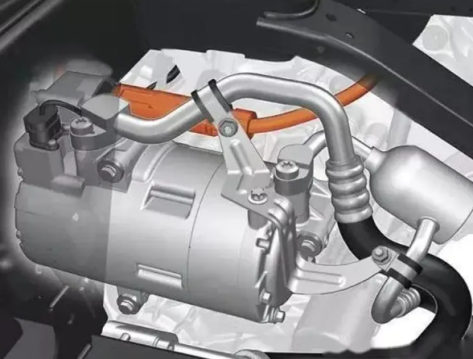
2. The automotive air conditioning refrigeration system is generally composed of a compressor, condenser, receiver-drier, expansion valve, evaporator, and blower. As shown in Figure 1, various components are connected using copper (or aluminum) tubes and high-pressure rubber hoses to form a closed system. When the cooling system operates, the refrigerant, which has memorized different states, circulates within this closed system, and each cycle consists of four basic processes: (1) Compression process: The compressor sucks in the low-temperature, low-pressure refrigerant gas at the outlet of the evaporator and compresses it into a high-temperature, high-pressure gas before discharging it from the compressor.
(2) Heat release process: The high-temperature and high-pressure superheated refrigerant gas enters the condenser, where due to the decrease in pressure and temperature, the refrigerant gas condenses into a liquid and releases a large amount of heat.
(3) Throttling process: The refrigerant liquid with higher temperature and pressure passes through the expansion device, where its volume increases and its pressure and temperature drop sharply, and is discharged from the expansion device in a mist form (as fine droplets).
(4) Heat absorption process: The misty refrigerant liquid enters the evaporator. Since the boiling point of the refrigerant at this time is much lower than the temperature inside the evaporator, the refrigerant liquid evaporates into a gas. During the evaporation process, it absorbs a large amount of heat from the surroundings. Then, the low-temperature and low-pressure refrigerant vapor enters the compressor.
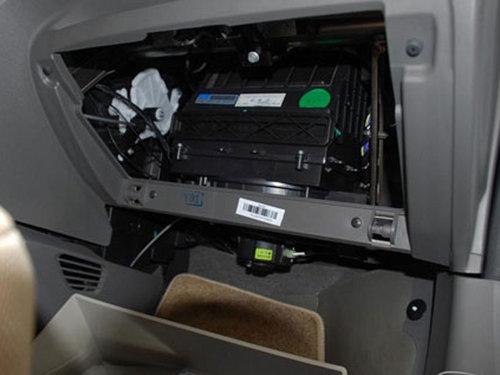
2. Operating Principle of BlowerTypically, the blower on a car is a centrifugal blower. The operating principle of a centrifugal blower is similar to that of a centrifugal fan, except that the air compression process is usually carried out through several working impellers (or stages) under the influence of centrifugal force. The blower has a high-speed rotating rotor, and the blades on the rotor drive the air to move at high speed. The centrifugal force causes the air to flow along the involute shape of the casing towards the blower outlet, and the high-speed airflow has a certain wind pressure. Fresh air enters from the center of the casing for replenishment.
Theoretically, the pressure-flow characteristic curve of a centrifugal blower is a straight line. However, due to internal frictional losses and other resistances in the fan, the actual pressure-flow characteristic curve gently declines as the flow rate increases, and correspondingly, the power-flow curve of the centrifugal fan rises with increasing flow rate. When the fan operates at a constant speed, its operating point moves along the pressure-flow characteristic curve. The operating point of the fan during operation depends not only on its own performance but also on the characteristics of the system. When the resistance in the pipe network increases, the performance curve of the pipeline becomes steeper. The basic principle of fan regulation is to change the fan's own performance curve or the external pipe network characteristic curve to achieve the desired operating condition. Therefore, some intelligent systems are installed on cars to help the air conditioning operate normally at low, medium, and high speeds.
3. Control Principle of Blower
2.1 Automatic Control
When the "Auto" switch on the air conditioning control panel is pressed, the air conditioning computer automatically adjusts the speed of the blower according to the required output air temperature.
When the airflow direction is set to "Face" or "Dual Direction", and the blower is in low speed mode, the blower speed will vary within a certain range based on the intensity of sunlight.
(1) Operation of low-speed control During low-speed control, the air conditioning computer disconnects the base voltage of the power transistor, and the power transistor and ultra-high-speed relay are also disconnected. Current flows from the blower motor to the blower resistor, then to the iron, causing the motor to operate at low speed. The air conditioning computer consists of the following seven parts: 1. Battery, 2. Ignition switch, 3. Heater relay, 4. Blower motor, 5. Blower resistor, 6. Power transistor, 7. Temperature fuse, 8. Air conditioning computer, 9. High-speed relay.
(2) Operation of Medium Speed Control During medium speed control, the power transistor is equipped with a temperature fuse, which protects the transistor from overheating damage. The air conditioning computer modulates the base current of the power transistor by altering the blower drive signal, thereby achieving wireless control of the blower motor speed.
(3) Operation of high-speed control During high-speed control, the air conditioning computer disconnects the base voltage of the power transistor, with its terminal 40 grounded, and the high-speed relay is turned on. Current flows from the blower motor through the high-speed relay and then to the ground, causing the motor to rotate at high speed.
2.2 Preheating In automatic control mode, the temperature sensor fixed under the heater core detects the temperature of the coolant and performs preheating control. When the coolant temperature is below 40℃ and the automatic switch is turned on, the air conditioning computer turns off the blower to prevent cold air from being discharged. Conversely, when the coolant temperature is above 40℃, the air conditioning computer starts the blower and rotates it at low speed. From then on, the blower speed is automatically controlled according to the calculated air flow rate and the required output air temperature.